
The label on a good loaf is a short piece of writing, and it rewards a slow read. "Sourdough", "wild yeast", "levain", "slow fermented" — these words get used loosely, sometimes honestly, sometimes as decoration. Knowing what each one actually commits a baker to makes the difference between paying for bread that is genuinely better and paying for a nice font.
None of these terms are regulated the way "organic" is. The label is a hint, not a guarantee. What follows is what these words usually mean, what they ought to mean, and how to check.
Sourdough Is a Method, Not a Flavour
A true sourdough is leavened by a living culture of wild yeasts and lactic acid bacteria, kept going in flour and water. No commercial yeast goes into the mix. That culture — call it a starter, levain, chef or mother — does three jobs at once: it raises the dough, it acidifies it, and it changes the structure of the crumb.
The acidity is what darkens the crust so deeply and what gives that faint tang. How much tang depends entirely on the baker. A stiff starter fed often produces a mild, almost sweet loaf. A wet starter left to ripen for hours gives something sharper and more assertively sour. So "sourdough" on a label tells you nothing about how sour the bread will taste.
When "sourdough" is just a flavouring
Some industrial loaves list "sourdough flavouring" or "sour dough powder" alongside yeast. That is dried fermented flour added for tang, while instant yeast does the actual lifting. It is not dishonest when declared, but the texture and keeping quality are different. A good rule: if the ingredient list runs longer than four or five items, ask why.
Wild Yeast, Commercial Yeast, and the Honest Middle
Wild yeast is whatever lives in your starter and your kitchen. Commercial yeast is a selected strain, sold fresh, dried or instant, and it is fast and predictable. Most small bakeries use one or the other, and a fair number use both — a starter for flavour, a pinch of yeast for consistency. That is a legitimate craft choice, as long as it is described as such.
"Naturally leavened" means no commercial yeast at all. "Yeast-raised" or "made with our starter" is vague enough to be worth a question.
What to ask at the counter
- Is there any commercial yeast in this loaf?
- Roughly how long is the bulk ferment, and is it retarded overnight?
- What flours are in it — white, wholemeal, stoneground, heritage?
- Was the grain milled nearby?
- How should I store it, and how long will it last?
Any baker who enjoys their work will answer these happily. Reluctance is information too.
Slow Fermentation: Where Flavour Actually Comes From
Time does things heat cannot. During a long ferment, enzymes break starch down into sugars, which is what browns the crust so richly. Bacteria produce acids that build flavour and subtly change the gluten. The dough relaxes, becoming easier to shape and giving a more open, glossy crumb that many people find easier to digest.
That last point comes with a caveat: slow fermentation does not make bread gluten-free, and it is not a treatment for coeliac disease. If you have a diagnosed condition or a genuine intolerance, take medical advice rather than bakery advice.
Rough timings, as a way of calibrating what you buy:
- Fast: one to two hours bulk, straight dough, commercial yeast.
- Medium: four to eight hours, often with a poolish or biga preferment.
- Slow: twelve to twenty-four hours or more, frequently cold-retarded in a fridge overnight.
Why the fridge matters
Chilling dough slows the yeast more than it slows the bacteria, so acidity keeps building while gas production creeps along. It also firms the dough, which makes the morning's shaping far easier. A long cold proof is behind much of what people describe, slightly vaguely, as "proper bakery flavour".
Decoding the Rest of the Label
- Unbleached — flour with nothing stripped out or added back. Normal for decent bread.
- Stoneground — milled between stones, usually retaining more wheat germ and oils. More flavour, shorter shelf life.
- Wholegrain or wholemeal — the whole grain, nothing removed. The two words are often used interchangeably.
- Levain — French for a sourdough starter. Same thing, different accent.
- Poolish, biga — preferments: flour, water and a little yeast left to ferment before the main mix.
- "Baked fresh daily" — true and close to meaningless. A bakery bakes daily by definition.
- "Artisan" — no legal definition. Ignore it and look at the crust instead.
- "No additives" — check the list. Emulsifiers, ascorbic acid and processing enzymes can hide behind "flour treatment agents".
Keeping quality is the giveaway
A long-fermented loaf stays softer for longer and toasts beautifully on day three. A fast industrial loaf is dry by the evening. If your "sourdough" turns chalky within a day, the fermentation was short, whatever the paper band says.
Judging a Loaf Without Reading a Word
Your senses are more reliable than the label. At the counter, or at home before you cut in:
- Crust: mahogany, not pale; it should crackle faintly as it cools.
- Base: tap it. A hollow sound means properly baked through.
- Weight: heavier than it looks for its size points to a wet dough and a long proof.
- Crumb: irregular holes, slightly glossy, never cottony or uniform.
- Smell: yoghurt and toasted wheat. Sharply vinegary usually means an over-fermented starter.
- Squeeze: it should spring back. If it stays compressed, it is underfermented or old.
Keeping It Well, and What to Do Next
Store cut-side down on a board or in a cotton bag; plastic makes the crust leathery within hours. Freeze it sliced if you will not finish it, and revive slices in a hot oven for five minutes rather than the microwave. Day-old bread becomes panzanella, croutons or bread pudding. Day-two sourdough makes the best toast of the week, because there is less water left to drive off, so it crisps instead of drying out.
The practical habit to take away is simple: buy from a bakery where you can ask a question and get a real answer. Read the ingredient list before the marketing. Then let the loaf itself — the crackle, the weight, the way it behaves on day three — tell you whether the words on the band were earned.
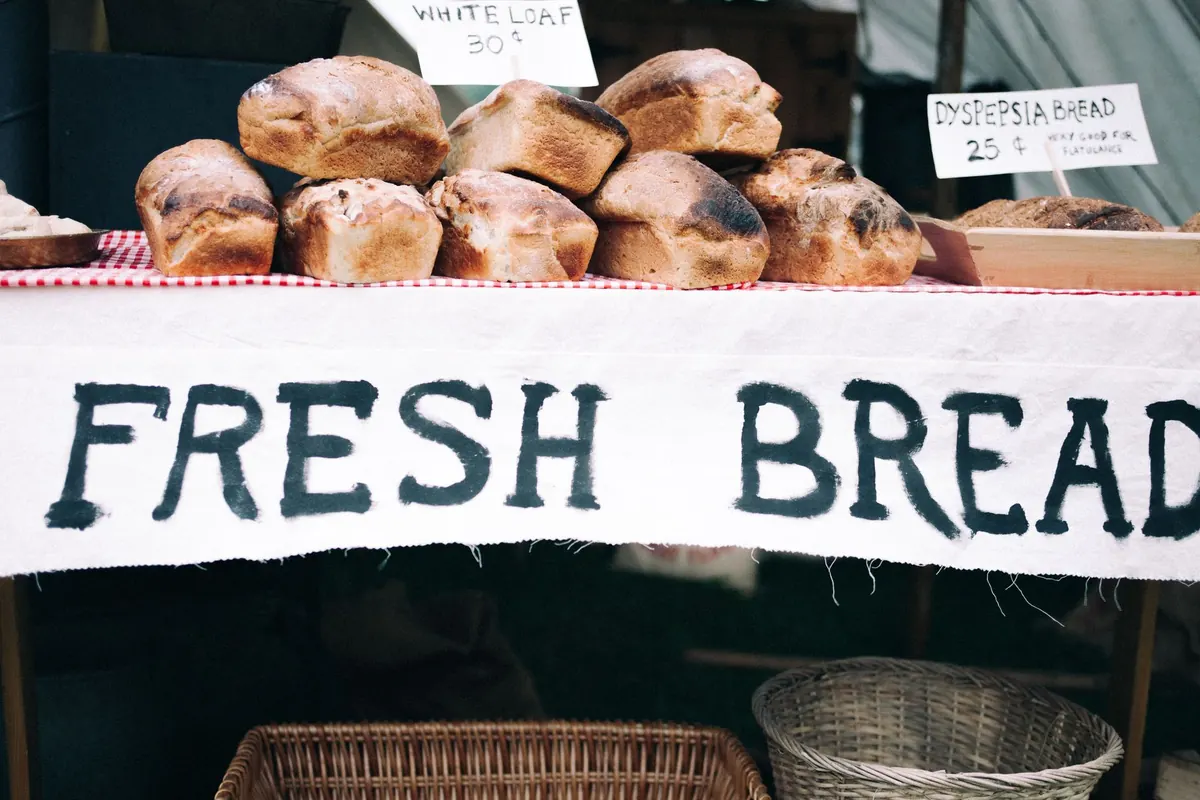
Photo: Clem Onojeghuo / Pexels